
Skhillz Academy
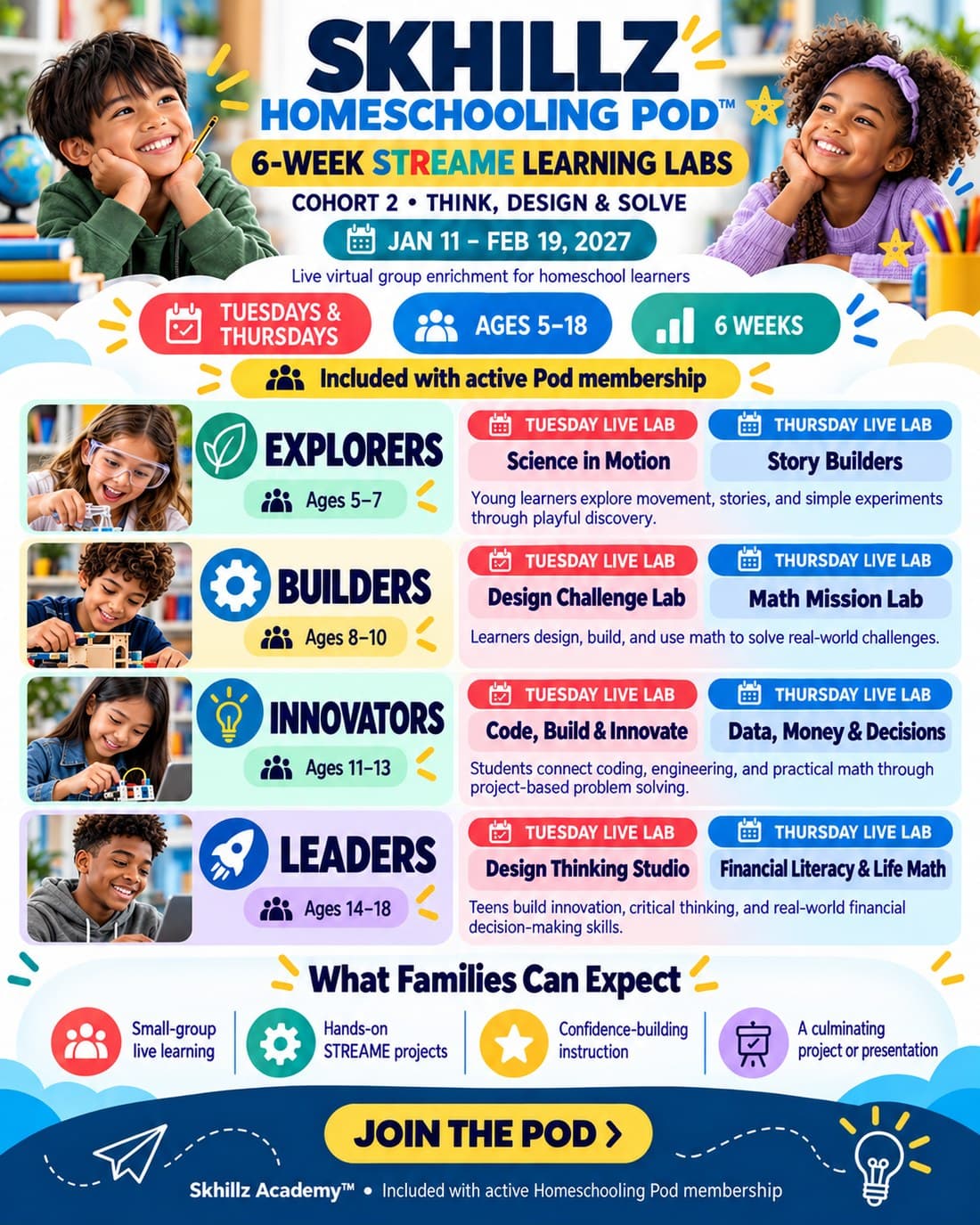
Skhillz Homeschool Pod

Cohort 2 · coming up

Think, Design & Solve

Tuesdays & ThursdaysAges 5 to 18Six weeks

January 11 to February 19, 2027

Six weeks on designing, testing and deciding. Engineering and code for the older pods, motion and story for the younger ones.

You buy one thing: a Skhillz Homeschool Pod membership. It runs from October to May and costs the same whichever cohort is on. A cohort is six weeks of that membership with its own theme. There are four in the year, and your membership covers all of them, so there is nothing to buy when one ends and the next begins.

Think, Design & Solve: what each pod does on Tuesdays and Thursdays

Choose your pod.

All four pods explore the same idea for the same six weeks. What changes is the depth, the reading level, the project and what a child is asked to do with it.

Explorers

Ages 5 to 745 minutes live, Tuesday and Thursday

Young learners make things move, then make stories move, and find out that changing one thing at a time is how you learn why.

Tuesday live lab

Science in Motion

Things that move. Ramps, wheels, marbles, moving water, a paper fan. Children make something go, then change one thing and watch what happens. They are learning that a change has an effect, and that the way to find out which change did it is to only change one thing at a time.

Thursday live lab

Story Builders

They build stories the way they built ramps. Somebody who wants something, a problem in the way, and an ending. Told out loud first, then drawn or written down. The Tuesday question, what happens if I change this, becomes what happens if she does this instead.

  • Science
  • Engineering
  • Reading
  • Arts

Skills practiced

  • Cause and effect
  • Changing one thing at a time
  • Telling a story in order
  • Saying out loud what they saw

By the end they can

  • Say which change made the difference and how they know
  • Tell a story that has a problem in the middle of it
  • Say what they think will happen before they try it
  1. Wk 1Discover: make something move, and say what made it move.
  2. Wk 2Explore: change one thing about it and watch what changes with it.
  3. Wk 3Build: make a ramp, a roller or a mover of their own.
  4. Wk 4Analyze: try somebody else's change and say which one worked better.
  5. Wk 5Improve: fix the part that keeps going wrong.
  6. Wk 6Share: show it moving at the Showcase and tell the story that goes with it.

The main project: Something that moves, made by them, and a short story about what it does.

What you will need
Cardboard, a cardboard tube, tape, string, marbles or a small ball, and a few household things named in the Monday plan a week ahead. Nothing to buy.
At home that week
Ten to fifteen minutes a day. One thing to build or move, a short read aloud, and one story question to answer out loud.
At the Showcase
Each Explorer shows their mover working and tells the story they built alongside it.

Builders

Ages 8 to 1060 minutes live, Tuesday and Thursday

Learners design against a rule, test what they built, and use the math to decide whether a change really helped.

Tuesday live lab

Design Challenge Lab

A challenge with a rule attached. The tallest tower from twenty straws, a boat that carries the most coins, a chair for a doll that holds a book. The rule is what turns making into designing. They sketch it, build it, test it, and then try to beat their own score.

Thursday live lab

Math Mission Lab

The math the challenge needed, done properly. Measuring, multiplying, averages, and working out whether a change actually helped or only felt like it did. Numbers with a job to do.

  • Engineering
  • Math
  • Technology
  • Arts

Skills practiced

  • Designing to a constraint
  • Measuring accurately
  • Working with averages
  • Comparing two results fairly
  • Sketching a plan before building

By the end they can

  • Explain what the rule forced them to change
  • Use a number to show that one design beat another
  • Redesign after a failed test without starting again from nothing
  1. Wk 1Discover: meet the challenge and the rule, and sketch a first plan.
  2. Wk 2Explore: build a rough version and take the first measurement.
  3. Wk 3Build: build the real one, and record the score.
  4. Wk 4Analyze: work out which change moved the score and which did nothing.
  5. Wk 5Improve: beat their own score, and write down what they changed.
  6. Wk 6Share: present the design and the numbers that show it got better.

The main project: A design that beat its own first attempt, with the measurements that prove it did.

What you will need
Straws, tape, cardboard, string, coins or small weights, a ruler, and a few household things named in the Monday plan a week ahead. Nothing to buy.
At home that week
About twenty minutes a day. One design or measuring task, a short piece of writing about what changed, and a math practice set.
At the Showcase
Builders present the before and after of their design and the numbers that separate them.

Innovators

Ages 11 to 1360 minutes live, Tuesday and Thursday

Students build something that actually runs, then use data to argue for a decision about it.

Tuesday live lab

Code, Build & Innovate

Code that makes something happen. A small program, a simulation, or a circuit that responds to something. They plan it, write it, watch it fail, and work out why. The debugging is the lesson rather than the obstacle.

Thursday live lab

Data, Money & Decisions

The numbers behind a decision. Real data, a budget and a trade off. They chart it, look for what the chart is hiding, and argue for a choice using the figures rather than a feeling.

  • Technology
  • Math
  • Engineering
  • English

Skills practiced

  • Planning before coding
  • Debugging
  • Reading a chart critically
  • Working to a budget
  • Defending a choice with figures

By the end they can

  • Say what a bug was and how they found it
  • Make a chart that answers a question somebody asked
  • Choose between two options and show the numbers that decided it
  1. Wk 1Discover: meet the problem and plan what the thing has to do before writing any of it.
  2. Wk 2Explore: build the smallest version that runs at all.
  3. Wk 3Build: make it do the real job, and keep a note of every bug.
  4. Wk 4Analyze: gather the data it produces and chart what it says.
  5. Wk 5Improve: change it on what the data showed rather than on a hunch.
  6. Wk 6Share: demonstrate it and explain one decision the numbers made for them.

The main project: Something that runs, and a chart that explains a decision they made about it.

What you will need
A device for the coding and charting. Household materials if their project needs a physical part, named in the Monday plan a week ahead.
At home that week
Twenty five to thirty minutes a day: a coding task, a data or budget exercise, and a short piece of writing explaining one decision.
At the Showcase
Innovators demonstrate what they built and defend one decision with the data behind it.

Leaders

Ages 14 to 1860 minutes live, Tuesday and Thursday

Teens design for somebody who is not them, and work the money math an adult life actually asks for.

Tuesday live lab

Design Thinking Studio

Design thinking as it is actually done. Interview somebody about a problem, define what they need rather than what you assumed they need, prototype it cheaply, test it on a real person, and change it on what they said.

Thursday live lab

Financial Literacy & Life Math

The money math an adult life asks for. A wage against a cost of living, interest, a repayment, and a budget that has to survive a bill nobody planned for. Worked with real numbers rather than discussed as a topic.

  • Engineering
  • Math
  • English
  • Technology

Skills practiced

  • Interviewing
  • Defining a need in somebody else's words
  • Rapid prototyping
  • Budgeting
  • Reading interest and repayment

By the end they can

  • Describe a need in the words of the person who has it
  • Show a prototype that changed because of what a real person said
  • Build a budget that survives an unexpected bill
  1. Wk 1Discover: interview somebody and write down what they said, not what you expected.
  2. Wk 2Explore: define the need in one sentence and test that sentence on them.
  3. Wk 3Build: prototype cheaply enough that throwing it away costs nothing.
  4. Wk 4Analyze: put it in front of a real person and record what went wrong.
  5. Wk 5Improve: change it on what they said rather than on what you preferred.
  6. Wk 6Share: present the need, the prototype and what the testing changed about it.

The main project: A prototype that visibly changed because of what a real person said, presented with the budget it would need.

What you will need
A notebook and a device. Cheap prototyping materials from the house: paper, card, tape. Nothing to buy.
At home that week
About thirty minutes a day: interview or research notes, a prototyping step, and a money math exercise with real figures.
At the Showcase
Leaders present the person they designed for, what changed after testing, and what it would cost to do properly.
Join the podWe place each child by age. You do not have to choose a pod.

Six weeks, six steps.

The topic changes every cohort. The shape does not, so a child always knows where they are in the work.

  1. Week 1

    Discover

    Meet the idea. Background knowledge, first questions, first look.

  2. Week 2

    Explore

    Guided practice and a deeper investigation of the same thing.

  3. Week 3

    Build

    Make it: create, write, design, test or apply.

  4. Week 4

    Analyze

    Compare what happened, talk it through, find what needs changing.

  5. Week 5

    Improve

    Refine the work and get the final piece ready.

  6. Week 6

    Share

    Present, demonstrate, publish or explain it to somebody else.

The days in between

A Home Plan appears every Monday by 8am Eastern: the project to extend, reading and writing prompts, a discussion question and the household things you will need. Wednesday and Friday are yours to use it.

The Showcase

Once a month every pod presents and parents come. This cohort ends on one, so the work has somewhere to go and somebody to show it to.

Every cohort is included with one membership.

Join the pod

Join once. Keep learning through every cohort.

Think, Design & Solve runs January 11 to February 19, 2027, and the first session is January 11, 2027.