
Skhillz Academy
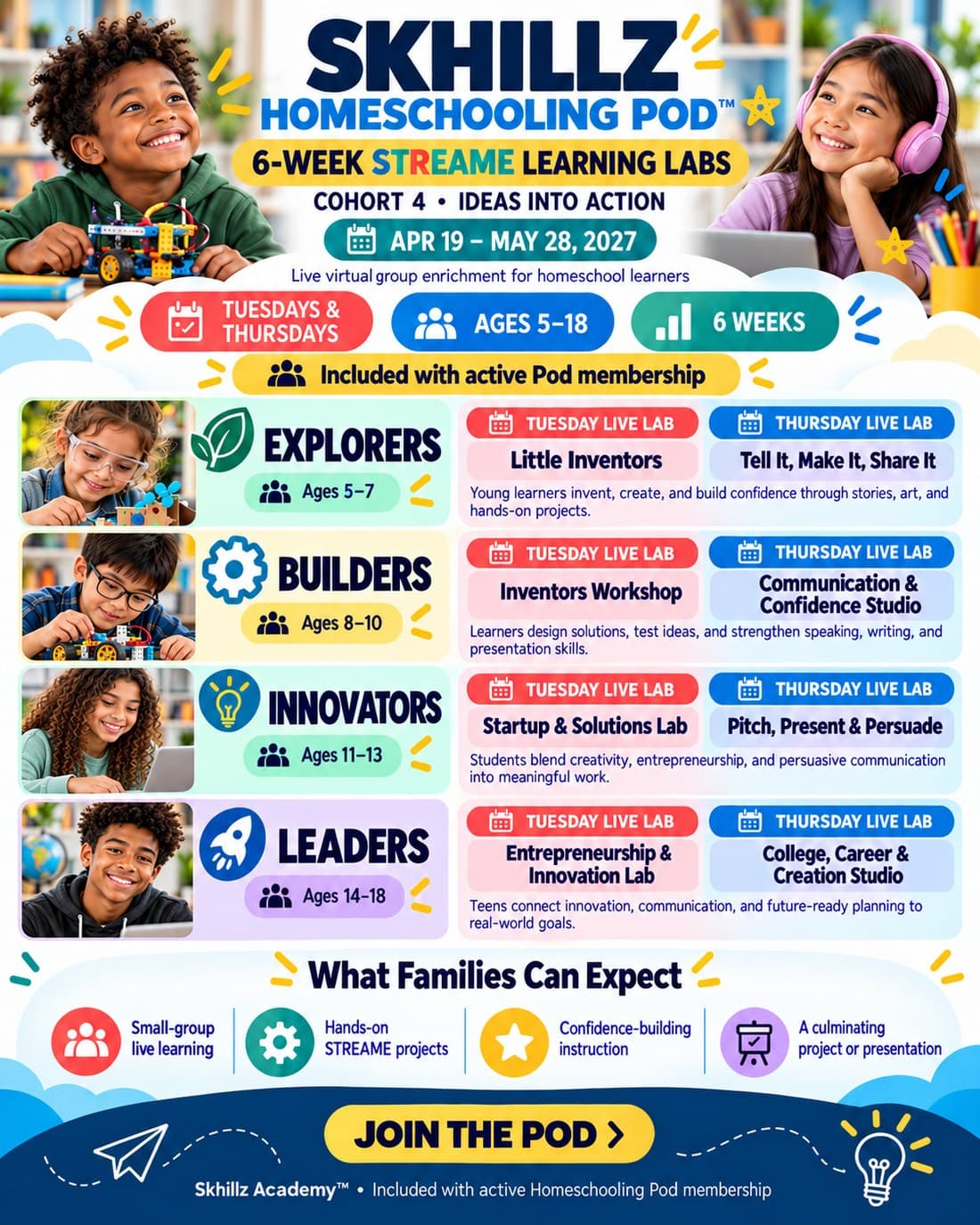
Skhillz Homeschool Pod

Cohort 4 · coming up

Ideas Into Action

Tuesdays & ThursdaysAges 5 to 18Six weeks

April 19 to May 28, 2027

The last six weeks. Every pod takes an idea and makes something of it, then presents it.

You buy one thing: a Skhillz Homeschool Pod membership. It runs from October to May and costs the same whichever cohort is on. A cohort is six weeks of that membership with its own theme. There are four in the year, and your membership covers all of them, so there is nothing to buy when one ends and the next begins.

Ideas Into Action: what each pod does on Tuesdays and Thursdays

Choose your pod.

All four pods explore the same idea for the same six weeks. What changes is the depth, the reading level, the project and what a child is asked to do with it.

Explorers

Ages 5 to 745 minutes live, Tuesday and Thursday

Young learners invent something small to fix a small problem, and practice telling people about it until saying it out loud feels ordinary.

Tuesday live lab

Little Inventors

Inventing something small that fixes something small. A holder for the pencils that keep rolling off, a way to carry something awkward, a gadget for a toy that does not quite work. They find a problem in their own house, make something out of what is already there, and try it out on the problem.

Thursday live lab

Tell It, Make It, Share It

Saying what they made, to people. Every week, out loud: what it is, what it is for, and what went wrong the first time. The audience is friendly and the same every week, so that by the Showcase, standing up and talking is an ordinary thing they have already done five times.

  • Engineering
  • Arts
  • English
  • Science

Skills practiced

  • Noticing a problem worth fixing
  • Making with what is already there
  • Saying what something is for
  • Speaking to a group

By the end they can

  • Name a problem in their own house and what they made for it
  • Say three sentences about their invention without being asked questions first
  • Try again after something did not work
  1. Wk 1Discover: hunt for a small problem at home and say out loud what is annoying about it.
  2. Wk 2Explore: try two different ideas for fixing it, roughly.
  3. Wk 3Build: make the one that seemed best, out of what is in the house.
  4. Wk 4Analyze: use it, and say what still does not work.
  5. Wk 5Improve: fix that one thing, and practice saying what it does.
  6. Wk 6Share: show it at the last Showcase of the year and say what it is for.

The main project: A small invention that fixes a real problem in their own house, and three sentences they can say about it on their own.

What you will need
Cardboard, tape, string, rubber bands, paper clips, glue, and whatever the problem they chose actually needs. All from the house.
At home that week
Ten to fifteen minutes a day. Work on the invention, and practice saying one sentence about it to somebody at home.
At the Showcase
The last Showcase of the year. Each Explorer holds up their invention and says what it is for, to a room that includes their parents.

Builders

Ages 8 to 1060 minutes live, Tuesday and Thursday

Learners invent something for somebody else, test it on that person, and practice saying it well enough that the invention is understood.

Tuesday live lab

Inventors Workshop

One real invention across six weeks. Find a problem somebody actually has, sketch more than one way to solve it, build the best of them, and then test it on the person with the problem rather than on themselves.

Thursday live lab

Communication & Confidence Studio

Communication taken apart into things that can be practiced: how to open, how to order the middle, what to do with your hands, and how to answer a question you were not expecting. Rehearsed with each other, recorded, and watched back.

  • Engineering
  • English
  • Arts
  • Technology

Skills practiced

  • Finding a problem somebody else has
  • Sketching more than one solution
  • Testing on a real user
  • Structuring what you say
  • Answering an unexpected question

By the end they can

  • Explain who their invention is for and what that person said about it
  • Give a short talk with a beginning, a middle and an end
  • Answer a question they were not expecting without losing the thread
  1. Wk 1Discover: find somebody with a problem and ask them about it properly.
  2. Wk 2Explore: sketch three solutions and pick one, saying why.
  3. Wk 3Build: build it well enough to be used, not well enough to be admired.
  4. Wk 4Analyze: put it in front of the person with the problem and write down what they said.
  5. Wk 5Improve: change it on what they said, and rehearse the talk on camera.
  6. Wk 6Share: present at the last Showcase and take a question.

The main project: An invention made for a named person, changed by what that person said, and a short talk that explains it.

What you will need
Cardboard, tape, glue, string, basic tools with an adult, and a device to record a rehearsal. All household.
At home that week
About twenty minutes a day. A build step, and one rehearsal of the talk, recorded and watched back once a week.
At the Showcase
The last Showcase of the year. Builders present the invention, say who it was for, and take one question.

Innovators

Ages 11 to 1360 minutes live, Tuesday and Thursday

Students work a small venture from problem to pitch, including deciding honestly whether it is worth doing.

Tuesday live lab

Startup & Solutions Lab

The whole arc of a small venture. A problem, who actually has it, what solving it would cost, what it could earn, and whether it is worth doing at all. The honest answer is sometimes no, and finding that out early is treated as a result rather than a failure.

Thursday live lab

Pitch, Present & Persuade

The pitch. How to open so people listen, what evidence to bring, what exactly you are asking for, and how to handle the question designed to find the hole. Practiced on each other, and the hard question is asked on purpose.

  • Technology
  • Math
  • English
  • Engineering

Skills practiced

  • Customer discovery
  • Estimating cost and revenue
  • Judging whether to continue
  • Structuring a pitch
  • Handling a hostile question

By the end they can

  • Describe the problem in the words of somebody who has it
  • Show the numbers that make their idea worth doing, or that do not
  • Say what would make them abandon their own idea
  1. Wk 1Discover: find the problem and talk to three people who have it.
  2. Wk 2Explore: size it. How many, how often, what do they do now instead.
  3. Wk 3Build: make the smallest thing that tests whether anybody wants it.
  4. Wk 4Analyze: cost it and earn it out on paper, and say whether the numbers hold.
  5. Wk 5Improve: change the idea, or say plainly that it should not go on.
  6. Wk 6Share: pitch it at the last Showcase and take the hard question.

The main project: A pitch backed by numbers they worked out themselves, including an honest statement of what would kill the idea.

What you will need
A device, a notebook, and cheap materials for whatever they build to test with. Nothing to buy.
At home that week
Twenty five to thirty minutes a day: one conversation or piece of research, a number worked out, and a pitch rehearsal.
At the Showcase
The last Showcase of the year. Innovators pitch, and are asked the question they would least like to be asked.

Leaders

Ages 14 to 1860 minutes live, Tuesday and Thursday

Teens work a venture through its real numbers, and turn the year into a portfolio, a resume and an answer they can give out loud.

Tuesday live lab

Entrepreneurship & Innovation Lab

A venture worked the way one is actually worked. Talk to the people with the problem, find out what it costs to serve one of them and what one of them is worth, and write a plan for the first ninety days that somebody else could follow.

Thursday live lab

College, Career & Creation Studio

The thing after school, made concrete. A portfolio of what they actually built this year, a resume that says what they did rather than what they attended, an application, and an interview answer rehearsed until it is theirs rather than recited.

  • Technology
  • Math
  • English
  • Engineering

Skills practiced

  • Customer discovery
  • Unit economics
  • Writing a plan somebody else could follow
  • Building a portfolio from real work
  • Rehearsing an interview answer

By the end they can

  • Say what it costs to serve one customer and what one is worth
  • Show a portfolio of work they made this year, not a list of things they attended
  • Give an interview answer about their own work without reciting it
  1. Wk 1Discover: talk to people with the problem, and write down what they said rather than what you hoped.
  2. Wk 2Explore: work out what it costs to serve one of them and what one is worth.
  3. Wk 3Build: write the ninety day plan, specific enough that somebody else could follow it.
  4. Wk 4Analyze: find the assumption the whole plan rests on, and test that one.
  5. Wk 5Improve: revise the plan, and assemble the portfolio from what they actually built this year.
  6. Wk 6Share: present the plan and the portfolio at the last Showcase of the year.

The main project: A ninety day plan resting on a tested assumption, and a portfolio of the year built from real work.

What you will need
A notebook and a device. Anything their own venture needs, which they cost out themselves.
At home that week
About thirty minutes a day: a conversation or research, a number, and one piece of the portfolio or a rehearsed answer.
At the Showcase
The last Showcase of the year. Leaders present the plan and the portfolio, and take questions from parents.
Join the podWe place each child by age. You do not have to choose a pod.

Six weeks, six steps.

The topic changes every cohort. The shape does not, so a child always knows where they are in the work.

  1. Week 1

    Discover

    Meet the idea. Background knowledge, first questions, first look.

  2. Week 2

    Explore

    Guided practice and a deeper investigation of the same thing.

  3. Week 3

    Build

    Make it: create, write, design, test or apply.

  4. Week 4

    Analyze

    Compare what happened, talk it through, find what needs changing.

  5. Week 5

    Improve

    Refine the work and get the final piece ready.

  6. Week 6

    Share

    Present, demonstrate, publish or explain it to somebody else.

The days in between

A Home Plan appears every Monday by 8am Eastern: the project to extend, reading and writing prompts, a discussion question and the household things you will need. Wednesday and Friday are yours to use it.

The Showcase

Once a month every pod presents and parents come. This cohort ends on one, so the work has somewhere to go and somebody to show it to.

Every cohort is included with one membership.

Join the pod

Join once. Keep learning through every cohort.

Ideas Into Action runs April 19 to May 28, 2027, and the first session is April 19, 2027.