
Skhillz Academy
Skhillz Homeschool Pod

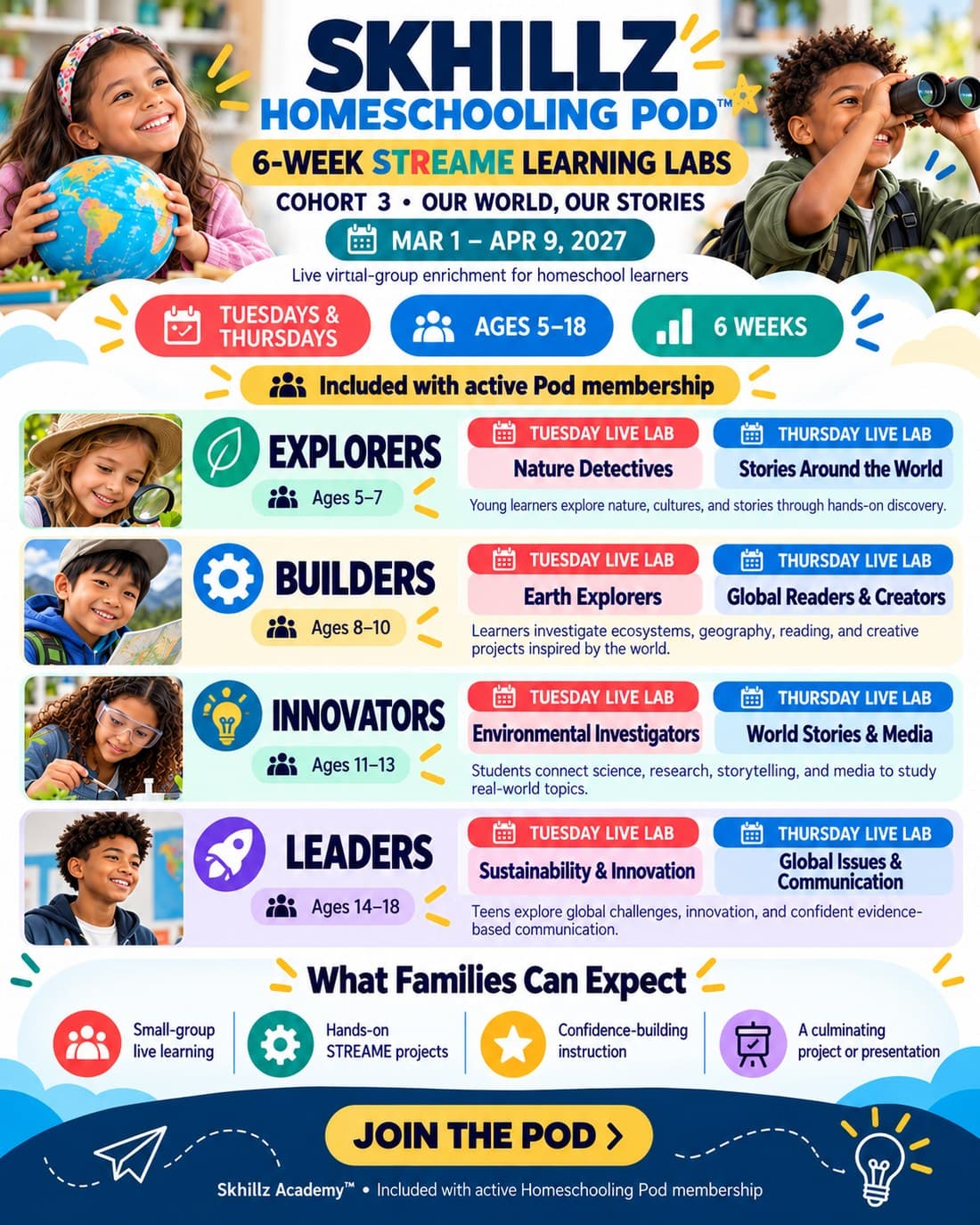
Cohort 3 · coming up

Our World, Our Stories

Tuesdays & ThursdaysAges 5 to 18Six weeks

March 1 to April 9, 2027

Six weeks looking outward: nature, place, people and the stories that come from them.

You buy one thing: a Skhillz Homeschool Pod membership. It runs from October to May and costs the same whichever cohort is on. A cohort is six weeks of that membership with its own theme. There are four in the year, and your membership covers all of them, so there is nothing to buy when one ends and the next begins.

Our World, Our Stories: what each pod does on Tuesdays and Thursdays

Choose your pod.

All four pods explore the same idea for the same six weeks. What changes is the depth, the reading level, the project and what a child is asked to do with it.

Explorers

Ages 5 to 745 minutes live, Tuesday and Thursday

Young learners look very closely at the world outside their own door, and meet a few stories from further away than that.

Tuesday live lab

Nature Detectives

Going outside, or to a window, and looking hard at one small thing. A leaf, an ant, a patch of sky, what the puddle did overnight. They collect what they notice, sort it into groups, and every week say what has changed since the last time they looked.

Thursday live lab

Stories Around the World

One story from somewhere else, read together, with the place it comes from found on a map. One story told properly rather than a tour of anywhere. They retell it in their own words and say one thing the child in it wanted that they want too.

  • Science
  • Reading
  • Arts
  • English

Skills practiced

  • Looking at the same thing over weeks
  • Sorting things into groups
  • Finding a place on a map
  • Retelling a story faithfully

By the end they can

  • Say what changed about something they watched for six weeks
  • Point out one thing a character wanted that they want as well
  • Sort a collection and say what the rule for sorting was
  1. Wk 1Discover: choose one small thing outside to watch for the whole six weeks.
  2. Wk 2Explore: collect and sort. What is the same, what is different, what is new this week.
  3. Wk 3Build: make a record of it. Drawings, a pressed leaf, a chart of what they counted.
  4. Wk 4Analyze: look back at week one and say what has changed since.
  5. Wk 5Improve: fill the gaps in the record and tidy it into something somebody else can read.
  6. Wk 6Share: show the record at the Showcase and say what surprised them.

The main project: A six week record of one small thing they watched, and the story they liked best with its place on a map.

What you will need
Paper, crayons, a folder or envelope to keep things in, and a window or a doorstep. A magnifying glass if you have one. Nothing to buy.
At home that week
Ten to fifteen minutes a day. Look at their thing and add to the record, one read aloud, and one question about the story.
At the Showcase
Each Explorer shows their six week record and says the one thing that surprised them most.

Builders

Ages 8 to 1060 minutes live, Tuesday and Thursday

Learners run one slow investigation about the earth, and read and write across more than one place while it grows.

Tuesday live lab

Earth Explorers

The earth up close. Soil, water, weather, what grows and what will not. They run one slow investigation across the whole six weeks: something planted, something measured every day, something that changes too slowly to notice without a record.

Thursday live lab

Global Readers & Creators

Reading from more than one place, and making something back. A book or an article set somewhere they have not been, then writing or building a response that would still make sense to somebody who lives there.

  • Science
  • Reading
  • English
  • Math

Skills practiced

  • Keeping a record across weeks
  • Measuring the same thing repeatedly
  • Reading for what is different
  • Writing for a reader who is not you

By the end they can

  • Show a six week record and say what it proves
  • Name one thing another place has that theirs does not, and why
  • Write for a reader somewhere else without treating their own life as the normal one
  1. Wk 1Discover: start the slow investigation and take the first measurement.
  2. Wk 2Explore: measure daily and read about somewhere the same thing works differently.
  3. Wk 3Build: chart what the record is showing, and write the first response.
  4. Wk 4Analyze: work out what the chart says and what it cannot say yet.
  5. Wk 5Improve: fix the record where it is thin and finish the writing.
  6. Wk 6Share: present the chart and read the piece they wrote.

The main project: A six week chart of something they measured themselves, and a piece of writing aimed at a reader somewhere else.

What you will need
Something to plant or measure, a container, soil or water, a ruler, and a notebook. All household, and named in the Monday plan a week ahead.
At home that week
About twenty minutes a day. Take the measurement, add to the chart, read the passage and answer two questions.
At the Showcase
Builders present the chart from their investigation and read the piece they wrote to go with it.

Innovators

Ages 11 to 1360 minutes live, Tuesday and Thursday

Students investigate an environmental question with measurements they took themselves, and look at how the same story changes depending on who is telling it.

Tuesday live lab

Environmental Investigators

A real environmental question answered with their own evidence. Water, waste, energy, air, and what their own household actually uses. They measure it, compare it against a published figure, and work out what a change would genuinely be worth.

Thursday live lab

World Stories & Media

How a story travels. They take one issue and look at how it is told in more than one place, by people with different reasons for telling it, then make their own piece about it and say plainly who it is for.

  • Science
  • Technology
  • English
  • Math

Skills practiced

  • Measuring a household baseline
  • Comparing against published data
  • Asking who is telling this and why
  • Making media for a named audience
  • Saying where a figure came from

By the end they can

  • Show what their own household uses and how they measured it
  • Name who is telling a story and what that changes about it
  • Produce something that states who it is for
  1. Wk 1Discover: choose the question and work out what could actually be measured at home.
  2. Wk 2Explore: take a baseline for a week and find a published figure to hold it against.
  3. Wk 3Build: make the change, keep measuring, and start the media piece.
  4. Wk 4Analyze: compare before and after, and be honest about what the numbers cannot prove.
  5. Wk 5Improve: strengthen the weakest claim, or drop it.
  6. Wk 6Share: present the finding and the piece, and say who it was made for.

The main project: A measured before and after from their own household, and a piece of media about it with a named audience.

What you will need
A device, a notebook, and whatever their question needs to measure: a jug, a scale, a meter reading. Named in the Monday plan a week ahead.
At home that week
Twenty five to thirty minutes a day: take the measurement, read one source and note who wrote it, and work on the media piece.
At the Showcase
Innovators present what they measured, what changed, and one claim they decided they could not support.

Leaders

Ages 14 to 1860 minutes live, Tuesday and Thursday

Teens cost out a real sustainability change, and learn to state an opposing position fairly before arguing against it.

Tuesday live lab

Sustainability & Innovation

Sustainability as an engineering and money problem rather than a slogan. They take one system they personally depend on, find where it leaks, and cost a change out properly, including what it would cost to do nothing.

Thursday live lab

Global Issues & Communication

An issue that crosses borders, argued from more than one side. They research the strongest version of a position they disagree with, present it fairly, and only then argue their own.

  • Engineering
  • Science
  • English
  • Math

Skills practiced

  • Systems thinking
  • Costing a change and costing inaction
  • Stating an opposing view at its strongest
  • Sourcing across borders
  • Presenting while being disagreed with

By the end they can

  • Show where a system they depend on loses something, with figures
  • State a position they disagree with well enough that somebody holding it would accept the summary
  • Argue a case and concede the strongest point against it
  1. Wk 1Discover: choose the system and map where it takes in and gives out.
  2. Wk 2Explore: find the leak, and find who has already tried to fix one like it.
  3. Wk 3Build: cost the change, including the cost of doing nothing.
  4. Wk 4Analyze: research the strongest case against it and write that case out properly.
  5. Wk 5Improve: revise the proposal on the strongest objection, not the weakest.
  6. Wk 6Share: present both sides, then say which one they hold and why.

The main project: A costed proposal with the strongest argument against it written out fairly, and answered.

What you will need
A notebook and a device. Bills, meter readings or receipts from their own household if the system they chose needs them.
At home that week
About thirty minutes a day: sourcing and note taking, costing work, and one written or spoken rehearsal.
At the Showcase
Leaders present the opposing case first, then their own, and take questions from parents.
Join the podWe place each child by age. You do not have to choose a pod.

Six weeks, six steps.

The topic changes every cohort. The shape does not, so a child always knows where they are in the work.

  1. Week 1

    Discover

    Meet the idea. Background knowledge, first questions, first look.

  2. Week 2

    Explore

    Guided practice and a deeper investigation of the same thing.

  3. Week 3

    Build

    Make it: create, write, design, test or apply.

  4. Week 4

    Analyze

    Compare what happened, talk it through, find what needs changing.

  5. Week 5

    Improve

    Refine the work and get the final piece ready.

  6. Week 6

    Share

    Present, demonstrate, publish or explain it to somebody else.

The days in between

A Home Plan appears every Monday by 8am Eastern: the project to extend, reading and writing prompts, a discussion question and the household things you will need. Wednesday and Friday are yours to use it.

The Showcase

Once a month every pod presents and parents come. This cohort ends on one, so the work has somewhere to go and somebody to show it to.

Every cohort is included with one membership.

Join the pod

Join once. Keep learning through every cohort.

Our World, Our Stories runs March 1 to April 9, 2027, and the first session is March 1, 2027.