
Skhillz Academy
Skhillz Homeschool Pod

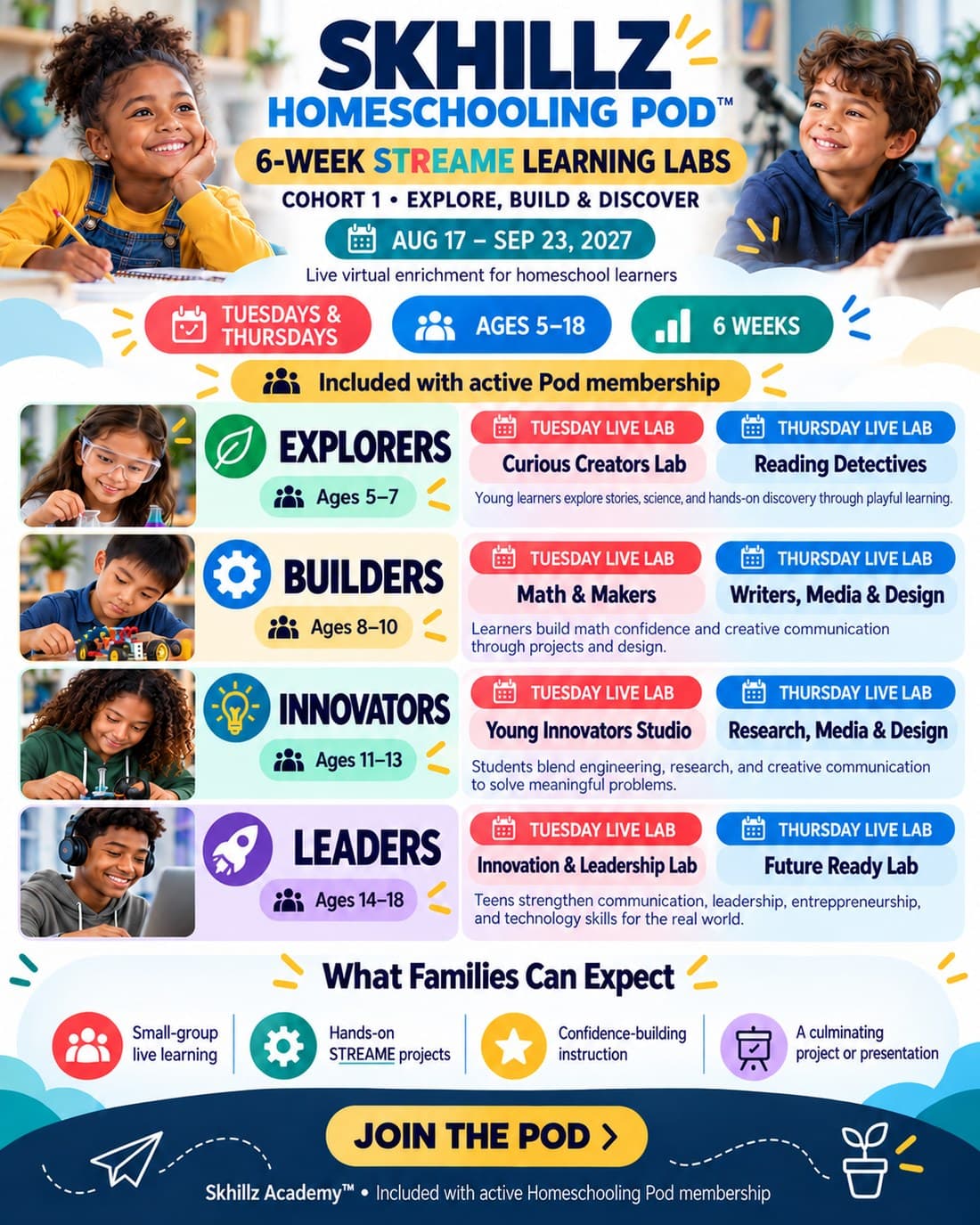
Cohort 1 · coming up

Explore, Build & Discover

Tuesdays & ThursdaysAges 5 to 18Six weeks

August 17 to September 23, 2027

The year opens with the same question every pod can answer at its own level: what happens if we try it and see.

You buy one thing: a Skhillz Homeschool Pod membership. It runs from October to May and costs the same whichever cohort is on. A cohort is six weeks of that membership with its own theme. There are four in the year, and your membership covers all of them, so there is nothing to buy when one ends and the next begins.

Explore, Build & Discover: what each pod does on Tuesdays and Thursdays

Choose your pod.

All four pods explore the same idea for the same six weeks. What changes is the depth, the reading level, the project and what a child is asked to do with it.

Explorers

Ages 5 to 745 minutes live, Tuesday and Thursday

Young learners start the year making things and hunting for what a story is not saying out loud.

Tuesday live lab

Curious Creators Lab

The first six weeks of a new year, so it starts with making things together. A tower, a boat, a bridge for a toy, a machine out of a box. Children try, watch it fall over, and try again, and they learn the pod is a place where the falling over is expected.

Thursday live lab

Reading Detectives

Reading as hunting. Short books and passages where something is hidden: who did it, what changed, what the picture says that the words do not. They find it, point at the page it is on, and say how they knew.

  • Engineering
  • Reading
  • Arts
  • Science

Skills practiced

  • Trying and trying again
  • Working next to other children
  • Finding evidence on the page
  • Saying how they know

By the end they can

  • Point at the part of a page that proves their answer
  • Say what they changed after something fell over
  • Take a turn and listen while somebody else takes theirs
  1. Wk 1Discover: meet the pod, and build the first thing badly on purpose.
  2. Wk 2Explore: find out what makes it stand up, by knocking it down.
  3. Wk 3Build: make the one they want to keep.
  4. Wk 4Analyze: look at somebody else's and say what theirs does better.
  5. Wk 5Improve: fix the weakest part.
  6. Wk 6Share: show it and read the part of a book they liked best.

The main project: Something they built that stands up, and a page they can read aloud and explain.

What you will need
Cardboard, tape, paper, blocks or boxes, and whatever the Monday plan names a week ahead. Nothing to buy.
At home that week
Ten to fifteen minutes a day: a building task and a short read aloud with one question.
At the Showcase
Explorers show what they built and read one short piece aloud.

Builders

Ages 8 to 1060 minutes live, Tuesday and Thursday

Learners use math to make something real, and present it as writing and design together rather than separately.

Tuesday live lab

Math & Makers

Math with something being made from it. Measuring, cutting to size, working out how much is needed before starting, and finding out what it costs to be wrong by half an inch.

Thursday live lab

Writers, Media & Design

Writing, media and design treated as one job: say the thing, show the thing, and make it look like somebody meant it. A short piece of writing, a diagram that carries half the meaning, and a layout that is a choice rather than an accident.

  • Math
  • Engineering
  • English
  • Arts

Skills practiced

  • Measuring before cutting
  • Estimating quantity
  • Writing to explain
  • Making a diagram that carries meaning
  • Laying something out on purpose

By the end they can

  • Work out what they need before they start, and say how close they got
  • Make a diagram somebody could follow without the words
  • Say why their layout looks the way it does
  1. Wk 1Discover: meet the build and work out what it will take.
  2. Wk 2Explore: measure, estimate, and find out what being wrong costs.
  3. Wk 3Build: make it to the measurements they worked out.
  4. Wk 4Analyze: compare what it took against what they estimated.
  5. Wk 5Improve: rebuild the part that was furthest out, and draft the explainer.
  6. Wk 6Share: present the build, the diagram and what the estimate got wrong.

The main project: Something built to their own measurements, with a diagram and a short written explainer.

What you will need
Cardboard, ruler or tape measure, scissors, tape, paper, and coloring or drawing tools. All household.
At home that week
About twenty minutes a day: a measuring or build step, and a piece of writing or a diagram.
At the Showcase
Builders present the build beside the diagram, and say where the estimate was wrong.

Innovators

Ages 11 to 1360 minutes live, Tuesday and Thursday

Students build something outside what they already know, and learn to show where their information came from.

Tuesday live lab

Young Innovators Studio

A build with an unknown in it. Something they have not made before, where the first week is spent finding out what they do not know and who already knows it.

Thursday live lab

Research, Media & Design

Research as a skill rather than a search. Where a fact came from, who paid for it, what is missing, and how to say all of that inside a piece of media somebody will actually watch or read.

  • Technology
  • Engineering
  • English
  • Science

Skills practiced

  • Finding what you do not know
  • Sourcing and citing
  • Judging who is behind a claim
  • Making media that survives scrutiny

By the end they can

  • Name what they did not know at the start and how they found out
  • Say where a figure came from and who produced it
  • Make something that shows its sources without becoming a bibliography
  1. Wk 1Discover: choose the build, and list what they do not know yet.
  2. Wk 2Explore: find out, and write down where each answer came from.
  3. Wk 3Build: make the first working version.
  4. Wk 4Analyze: find the weakest source they relied on and replace it.
  5. Wk 5Improve: rebuild on better information, and draft the media piece.
  6. Wk 6Share: present the build and show the sources behind it.

The main project: Something built from research they did themselves, presented with its sources visible.

What you will need
A device, a notebook, and household materials for the build, named in the Monday plan a week ahead.
At home that week
Twenty five to thirty minutes a day: a build step, a source found and noted, and a media draft.
At the Showcase
Innovators present the build and answer where a number came from.

Leaders

Ages 14 to 1860 minutes live, Tuesday and Thursday

Teens run a project that depends on other people, and practice the communication that makes that survivable.

Tuesday live lab

Innovation & Leadership Lab

Leading something small and real. They take on a project that needs other people, split it, agree who does what, and find out what happens when somebody does not do their part.

Thursday live lab

Future Ready Lab

The skills the next thing after school asks for, started early: writing clearly, running a meeting, saying no, and giving somebody feedback they can act on rather than feedback that only feels honest.

  • English
  • Technology
  • Engineering
  • Arts

Skills practiced

  • Splitting work
  • Running a short meeting
  • Giving usable feedback
  • Saying no clearly
  • Writing so somebody can act on it

By the end they can

  • Show a plan where the work is split and the owners are named
  • Give feedback somebody could actually act on
  • Say what they did when somebody did not deliver
  1. Wk 1Discover: choose a project that genuinely needs more than one person.
  2. Wk 2Explore: split it, name owners, and agree what done looks like.
  3. Wk 3Build: do the work, and run one short meeting a week.
  4. Wk 4Analyze: find where it slipped, and say why without blaming a person.
  5. Wk 5Improve: change how the work is organized, not how hard people are trying.
  6. Wk 6Share: present what was built and what the team learned about itself.

The main project: A finished piece of shared work, with an honest account of where it nearly came apart.

What you will need
A notebook and a device. Anything the project itself needs.
At home that week
About thirty minutes a day: their own share of the work, and one piece of written communication to the team.
At the Showcase
Leaders present the shared project and what they would organize differently.
Join the podWe place each child by age. You do not have to choose a pod.

Six weeks, six steps.

The topic changes every cohort. The shape does not, so a child always knows where they are in the work.

  1. Week 1

    Discover

    Meet the idea. Background knowledge, first questions, first look.

  2. Week 2

    Explore

    Guided practice and a deeper investigation of the same thing.

  3. Week 3

    Build

    Make it: create, write, design, test or apply.

  4. Week 4

    Analyze

    Compare what happened, talk it through, find what needs changing.

  5. Week 5

    Improve

    Refine the work and get the final piece ready.

  6. Week 6

    Share

    Present, demonstrate, publish or explain it to somebody else.

The days in between

A Home Plan appears every Monday by 8am Eastern: the project to extend, reading and writing prompts, a discussion question and the household things you will need. Wednesday and Friday are yours to use it.

The Showcase

Once a month every pod presents and parents come. This cohort ends on one, so the work has somewhere to go and somebody to show it to.

Every cohort is included with one membership.

Join the pod

Join once. Keep learning through every cohort.

Explore, Build & Discover runs August 17 to September 23, 2027, and the first session is August 17, 2027.