
Skhillz Academy
Skhillz Homeschool Pod

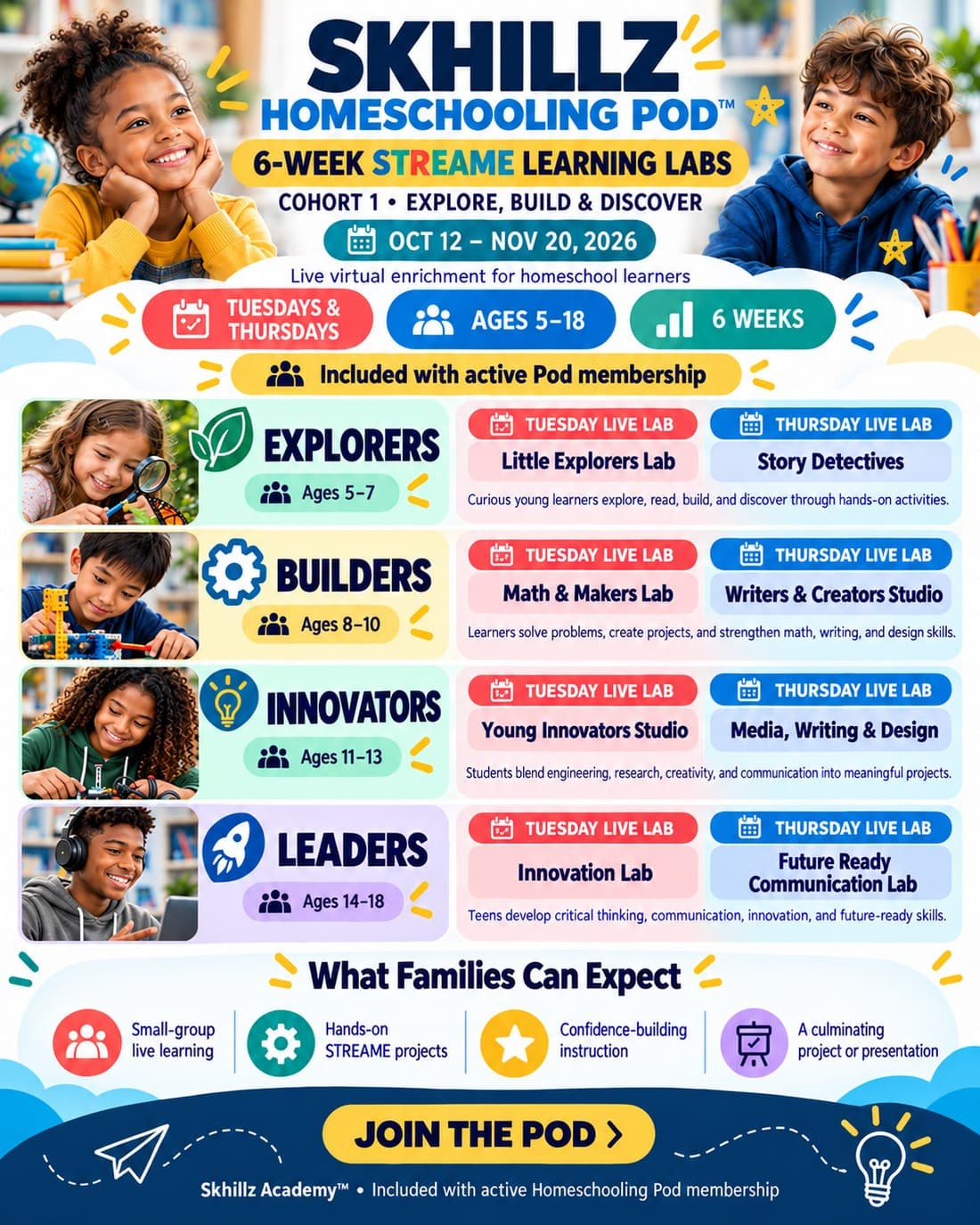
Cohort 1 · running now

Explore, Build & Discover

Tuesdays & ThursdaysAges 5 to 18Six weeks

October 12 to November 20, 2026

The first six weeks. Every pod explores a related idea at its own level, then shares what they made at the November Showcase.

You buy one thing: a Skhillz Homeschool Pod membership. It runs from October to May and costs the same whichever cohort is on. A cohort is six weeks of that membership with its own theme. There are four in the year, and your membership covers all of them, so there is nothing to buy when one ends and the next begins.

Explore, Build & Discover: what each pod does on Tuesdays and Thursdays

Choose your pod.

All four pods explore the same idea for the same six weeks. What changes is the depth, the reading level, the project and what a child is asked to do with it.

Explorers

Ages 5 to 745 minutes live, Tuesday and Thursday

Explorers spend Tuesday finding out whether their guess was right, and Thursday finding what a writer left hidden in a story.

Tuesday live lab

Little Explorers Lab

Every Tuesday starts with something to look at closely: a seed, a magnet, a cup of water, a handful of blocks. Children say what they think will happen, try it, and then say what they actually noticed. They are learning to ask a question out loud, to guess before they know, and to change their mind when what they see does not match what they thought.

Thursday live lab

Story Detectives

A short story read together, with children hunting for what the writer left for them: who wants something, what goes wrong, what is different by the end. They retell it in their own words and draw the part that mattered most. Early comprehension done as a hunt rather than a worksheet.

  • Science
  • Reading
  • Arts

Skills practiced

  • Predicting
  • Looking closely and saying what you see
  • Retelling a story in order
  • Asking a question out loud

By the end they can

  • Say what they expected and what actually happened
  • Retell a story with a beginning, a middle and an end
  • Point to the moment in a story where something changed
  1. Wk 1Discover: meet the question. Something to look at closely, a guess said out loud, and a first try.
  2. Wk 2Explore: try it again, changing one thing, and notice what changes with it.
  3. Wk 3Build: make something that shows what they found. A model, a drawing, a little book.
  4. Wk 4Analyze: put their work next to somebody else's and say what is different about it.
  5. Wk 5Improve: fix the part that did not work, and get it ready to show.
  6. Wk 6Share: show it at the Showcase and say one sentence about it.

The main project: Something they made themselves and can hold up, with one sentence they can say about why it works.

What you will need
Paper, crayons or markers, tape, and child scissors with an adult nearby. A few household things are named in the Monday plan a week ahead: a cup, a magnet, dried beans, a shoebox. Nothing to buy.
At home that week
Ten to fifteen minutes a day. A short read aloud, one thing to draw or build, and one question to talk about at dinner.
At the Showcase
Each Explorer holds up what they made and says one sentence about it, with their parents in the room.

Builders

Ages 8 to 1060 minutes live, Tuesday and Thursday

Learners build things that only stand up if the measuring was right, then write the build up clearly enough for another child to copy it.

Tuesday live lab

Math & Makers Lab

Children get a problem that needs building: a bridge that holds weight, a container that keeps something cold, a ramp that sends a marble furthest. They estimate first, measure as they go, and write down what happened. The math is real here because the build fails without it.

Thursday live lab

Writers & Creators Studio

They write about what they built. Either instructions somebody else could follow, or the story of what went wrong and how they fixed it. Then they read it to the group and find out whether it was actually clear. Writing for an audience that answers back.

  • Math
  • Engineering
  • English
  • Technology

Skills practiced

  • Estimating
  • Measuring
  • Recording what happened
  • Writing instructions somebody can follow
  • Revising after feedback

By the end they can

  • Explain why a first attempt failed and what they changed
  • Write steps another child could actually follow
  • Use a measurement to defend a decision
  1. Wk 1Discover: meet the build problem and write down a guess at how it will go. Week four needs that guess.
  2. Wk 2Explore: measure what there is to work with, and test one idea small before committing to it.
  3. Wk 3Build: make the first real version, and write down what happened when it was tested.
  4. Wk 4Analyze: compare the result against the week one guess and work out where the difference came from.
  5. Wk 5Improve: change one thing, test again, and write the instructions somebody else would follow.
  6. Wk 6Share: present the build and read the instructions out while somebody tries to follow them.

The main project: A working build with written instructions clear enough that another child could make it.

What you will need
Cardboard, tape, string, a ruler or tape measure, scissors, and a few household things named in the Monday plan a week ahead. Nothing to buy.
At home that week
About twenty minutes a day. One build or measuring task, one piece of writing, and a reading passage with two questions.
At the Showcase
Builders demonstrate what they made and read their instructions aloud while somebody else tries to follow them.

Innovators

Ages 11 to 1360 minutes live, Tuesday and Thursday

Students design against a limit somebody else set, test what they made, and write it up for people who were not in the room.

Tuesday live lab

Young Innovators Studio

A design brief with a real constraint on it: a budget, a material limit, a deadline. Students research, sketch, build something that works well enough to test, test it, and report what the test showed. The lesson underneath is that a good idea and a working idea are different things.

Thursday live lab

Media, Writing & Design

They turn the week's work into something other people can understand: a short explainer, a labeled diagram, a piece of writing with a point of view. Most of the attention goes on what an audience already knows and what it still needs told.

  • Engineering
  • Technology
  • English
  • Arts

Skills practiced

  • Research
  • Prototyping
  • Testing against a constraint
  • Explaining technical work to somebody outside it
  • Designing for an audience

By the end they can

  • Defend a design decision with what a test showed
  • Explain a technical idea to somebody who does not share the vocabulary
  • Make something for a stated audience and say who it is for
  1. Wk 1Discover: meet the brief and the constraint on it. Find out who has solved something like it before.
  2. Wk 2Explore: sketch three ways it could go, and argue for one of them.
  3. Wk 3Build: make a prototype good enough to test rather than good enough to admire.
  4. Wk 4Analyze: test it, record what the test showed, and say what that means rather than what was hoped.
  5. Wk 5Improve: change the design on the evidence, and test it again.
  6. Wk 6Share: publish a short explainer somebody outside the project can follow, and present it.

The main project: A tested prototype and a short explainer, both saying what the test actually showed rather than what was hoped.

What you will need
Household materials for the prototype and a device for the media work. Anything specific is named in the Monday plan a week ahead.
At home that week
Twenty five to thirty minutes a day: research notes, a design sketch or a build step, and a piece of writing aimed at a named audience.
At the Showcase
Innovators present the prototype and the explainer, and take a question from the floor.

Leaders

Ages 14 to 1860 minutes live, Tuesday and Thursday

Teens take a problem they already care about and work it the way work is done: defined, researched, proposed, and then argued with.

Tuesday live lab

Innovation Lab

Students take a problem they actually care about, in their home, their town or a field they are interested in, and work it properly: define it, find out who has tried before, propose something, then stress test the proposal against what could go wrong. Closer to how work is done than to how school is done.

Thursday live lab

Future Ready Communication Lab

The part that decides whether an idea goes anywhere: writing it clearly, saying it out loud, and answering a hard question without losing the thread. They present to the group and get asked the difficult question on purpose.

  • Engineering
  • Technology
  • English
  • Science

Skills practiced

  • Defining a problem precisely
  • Research and sourcing
  • Persuasive writing
  • Presenting under questioning
  • Giving and taking critique

By the end they can

  • State a problem precisely enough that somebody else could work on it
  • Present a proposal and answer a question they did not plan for
  • Critique somebody else's work without flattening it
  1. Wk 1Discover: choose the problem and state it precisely enough that somebody else could work on it.
  2. Wk 2Explore: find out who has tried before, and what happened to them.
  3. Wk 3Build: draft the proposal, including what it would cost and what it would need.
  4. Wk 4Analyze: stress test it against what could go wrong, and against somebody who disagrees.
  5. Wk 5Improve: revise on the strongest objection rather than the easiest one.
  6. Wk 6Share: present it, and answer a question nobody warned them was coming.

The main project: A proposal they can defend out loud, with the strongest objection to it named and answered.

What you will need
A notebook and a device. Nothing else, unless their own project needs it.
At home that week
About thirty minutes a day: research and sourcing, drafting, and either a short piece of writing or a rehearsal recorded and watched back.
At the Showcase
Leaders present their proposal to parents and take unplanned questions.
Join the podWe place each child by age. You do not have to choose a pod.

Six weeks, six steps.

The topic changes every cohort. The shape does not, so a child always knows where they are in the work.

  1. Week 1

    Discover

    Meet the idea. Background knowledge, first questions, first look.

  2. Week 2

    Explore

    Guided practice and a deeper investigation of the same thing.

  3. Week 3

    Build

    Make it: create, write, design, test or apply.

  4. Week 4

    Analyze

    Compare what happened, talk it through, find what needs changing.

  5. Week 5

    Improve

    Refine the work and get the final piece ready.

  6. Week 6

    Share

    Present, demonstrate, publish or explain it to somebody else.

The days in between

A Home Plan appears every Monday by 8am Eastern: the project to extend, reading and writing prompts, a discussion question and the household things you will need. Wednesday and Friday are yours to use it.

The Showcase

Once a month every pod presents and parents come. This cohort ends on one, so the work has somewhere to go and somebody to show it to.

Every cohort is included with one membership.

Join the pod

Join once. Keep learning through every cohort.

Explore, Build & Discover runs October 12 to November 20, 2026, and the first session is October 12, 2026.

Explore, Build & Discover | Skhillz Homeschool Pod | Skhillz Academy